Convergence Insufficiency Exercises You Can Do at Home
Updated
Written by the Optics Trainer team from published research, with every source linked below. Not yet reviewed by a clinician.
Convergence insufficiency exercises are eye-teaming drills that help both eyes turn inward together for close work like reading. Pencil push-ups, the Brock string, computer programs and apps are common ways to do them at home. They can help many people, but the research is clear that not all programs work equally well, and the best-studied approach includes weekly visits with a clinician. This guide covers the symptoms, the main exercises, what the big trials found about home practice, and how to use convergence insufficiency training safely as part of your eye care professional's plan.
What is convergence insufficiency? Symptoms to know
Convergence insufficiency (CI) means your eyes have trouble turning in together when you look at something close. One or both eyes may drift outward. The American Academy of Ophthalmology (AAO) says it is most common in children and young adults, and that school vision screenings often miss it.
Symptoms usually show up during reading or screen work. The AAO lists:
- Double vision up close
- Headaches
- Blurry vision while reading
- Squinting or closing one eye
- Words that seem to move or float
- Eye strain or tiredness
Get diagnosed before starting convergence insufficiency exercises
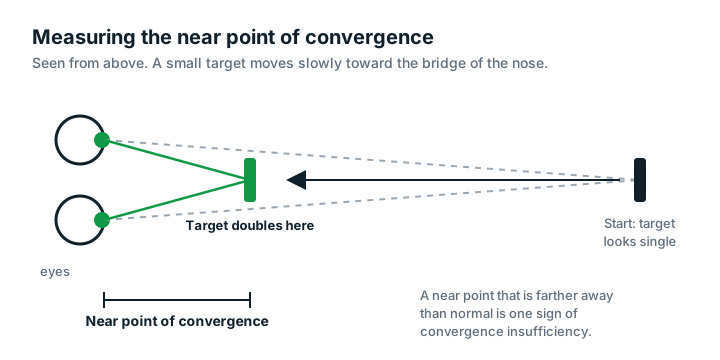
These symptoms can also come from needing glasses or from a focusing problem. An ophthalmologist, optometrist or orthoptist can confirm CI with a few measurements, such as your near point of convergence (how close you can bring a target before it doubles) and your fusional vergence (how much your eyes can turn in while keeping one clear image). They will also check whether you need glasses, which should be corrected first.
Both the AAO and AAPOS say that people who meet the test criteria but have no symptoms do not need treatment. If you have symptoms, ask for a comprehensive eye exam with a binocular vision evaluation.
Common convergence insufficiency exercises at home
Your clinician will choose exercises and set how often to do them. These are the ones you will hear about most:
- Pencil push-ups: Hold a pencil with small letters at arm's length and slowly bring it toward the bridge of your nose while keeping the letters single and clear. In the CITT trial, children did this 15 minutes a day, 5 days a week.
- Brock string: A long string with several colored beads. One end is held at the nose and you practice aiming both eyes at each bead. It is part of many clinic-designed convergence programs. Get setup instructions from your clinician, since even the maker says instructions should come from your eye care provider.
- Convergence cards and stereograms: Printed cards that help you practice turning the eyes in and holding one image.
- Computer and app programs: Software that shows each eye a slightly different image and makes the task harder as you improve.
What the research says about convergence insufficiency training
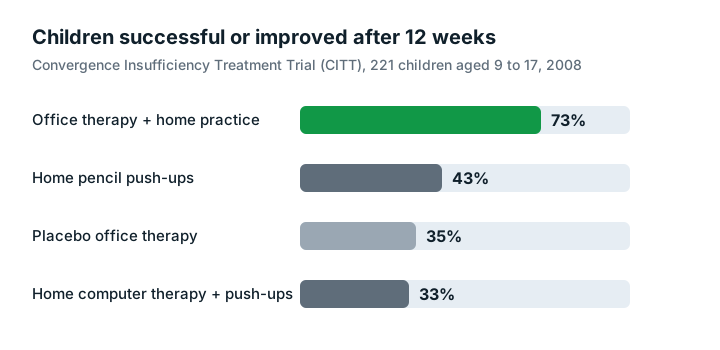
The Convergence Insufficiency Treatment Trial (CITT) is the largest study of these exercises. Published in 2008 in Archives of Ophthalmology, it followed 221 children aged 9 to 17 for 12 weeks. Children were placed in one of four groups. After 12 weeks, about 73% of children who had weekly office therapy plus home practice were successful or improved. That compared with 43% for home pencil push-ups, 33% for home computer therapy plus push-ups, and 35% for placebo office therapy.
Office therapy beat every other group on symptoms and on eye-teaming measures. The two home-only groups did no better than placebo on symptoms. They did bring the near point of convergence closer than placebo, but that did not show up as fewer symptoms in this trial.
A 2020 Cochrane review of 12 trials concluded that, for children, office therapy with home practice has the strongest evidence. There are fair caveats to keep in mind:
- The office group got more total practice time and more contact with a therapist. One AAO commentary argued this makes it hard to say office care beats a more intensive home plan.
- The push-up group had more follow-up than most people get in everyday care, so push-ups alone may work even less well in real life.
- AAPOS takes a softer line, saying home treatment is often enough and no single option is clearly best.
- Evidence in adults is much thinner than in children.
Will convergence insufficiency exercises help with reading?
Many parents look into CI because a child struggles with reading. A follow-up trial called CITT-ART tested this directly in 310 children aged 9 to 14. It was published in 2019 in Optometry and Vision Science.
After 16 weeks, office therapy clearly improved eye teaming. About 78% of children in the therapy group met the study's convergence success measure, compared with 29% in the placebo group. But reading scores improved about the same in both groups. Symptoms also improved by a similar amount with real and placebo therapy. The researchers advised clinicians not to tell families that this therapy will, on average, raise standardized reading scores.
The AAO also notes that convergence insufficiency does not cause learning disabilities. If a child is struggling to read, an eye exam is a good step, and so is talking with the child's pediatrician and school.
Can convergence insufficiency be cured?
For many people, symptoms get much better. The AAO says exercises relieve symptoms in about 70 percent of patients. AAPOS says some patients may be permanently cured after exercises.
In a one-year CITT follow-up, most children who became symptom-free after office therapy were still symptom-free a year later. But CI can come back. AAPOS notes that illness, lack of sleep or a jump in close work can bring symptoms back, and another round of exercises may help. The Cambridge University Hospitals leaflet also warns that symptoms can feel worse before they get better, which is a good reason to stay in touch with your clinician.
For adults, the picture is less certain. The Cochrane review found few, small adult trials and less clear results.
Vision therapy apps for convergence insufficiency
Apps and computer programs make home practice easier to fit into a busy day. But the home computer program in CITT did not beat placebo on symptoms, so an app on its own is not proven to treat CI. The best use of an app is as home practice inside a plan your eye care professional sets and checks.
Optics Trainer is a set of game-based vision and brain training apps for iPhone, iPad, Android, web browsers and Meta Quest. It includes games for eye teaming, convergence and divergence, depth, and visual reaction, plus games where each eye gets its own target while both stay open. It is a way to practice visual skills at home. It is not a diagnosis or treatment, and it was not tested in the trials above.
Optics Trainer is not a substitute for professional diagnosis or prescribed care. Consult your eye care professional for guidance about your specific condition. If home practice fits your plan, you can try the apps free for 7 days, then mobile and web access is $14.99 a month.
Frequently asked questions
Do convergence insufficiency exercises work?
Exercises help many people. The AAO says they relieve symptoms in about 70 percent of patients. In children, the strongest evidence is for weekly office therapy with home practice. Home-only pencil push-ups and home computer therapy did not beat placebo on symptoms in the CITT trial.
Can I treat convergence insufficiency at home?
Some people do well with home exercises, and AAPOS says home treatment is often enough. But the largest trial in children found office therapy with home practice worked better. Get diagnosed first, then ask your clinician whether a home plan is right for you and how often to recheck.
How long do pencil push-ups take to work?
In the CITT trial, children did pencil push-ups 15 minutes a day, 5 days a week, and were assessed after 12 weeks. Results vary from person to person, so ask your clinician when to expect a recheck.
Is the Brock string good for convergence insufficiency?
The Brock string is a common part of clinic-designed convergence programs. It has not been tested on its own in a large trial. Ask your eye care professional to show you how to set it up and use it.
Can convergence insufficiency come back?
Yes. The AAO and AAPOS both say symptoms can return, for example after illness, poor sleep or more close work. Another round of exercises may help.
Are there vision therapy apps for convergence insufficiency?
Yes, there are apps and computer programs for eye-teaming practice, including Optics Trainer. No app has been shown on its own to treat CI. Use one as home practice alongside your eye care professional's plan.
Sources
- CITT Investigator Group. A randomized clinical trial of treatments for symptomatic convergence insufficiency in children. Arch Ophthalmol. 2008
- Wallace DK. Commentary on the Convergence Insufficiency Treatment Trial. American Academy of Ophthalmology, Editors' Choice. 2008
- CITT Study Group. Long-term effectiveness of treatments for symptomatic convergence insufficiency in children. Optom Vis Sci. 2009
- CITT-ART Investigator Group. Effect of vergence/accommodative therapy on reading in children with convergence insufficiency. Optom Vis Sci. 2019
- National Eye Institute. Treatment for common vision disorder does not improve children's reading skills. 2019
- Scheiman M, et al. Interventions for convergence insufficiency: a network meta-analysis. Cochrane Database Syst Rev. 2020
- American Academy of Ophthalmology. Convergence insufficiency
- AAPOS. Convergence insufficiency
- AAO EyeWiki. Convergence insufficiency
- Cambridge University Hospitals NHS Foundation Trust. Convergence insufficiency (CI)
- Orthoptic therapy in children with intermittent exotropia after surgery: study protocol (training adapted from CITT). Trials. 2022