Home Vision Therapy: What It Is, What Works, and How to Start
Updated
Written by the Optics Trainer team from published research, with every source linked below. Not yet reviewed by a clinician.
Home vision therapy means practicing eye and brain skills at home, often with exercises, cards, a computer program or an app. Many families look for vision therapy at home because clinic visits take time and money. That makes sense. But the research gives a mixed answer about how well home-only programs work, and the answer depends a lot on the condition. This guide explains what home vision therapy is, what the studies found for convergence insufficiency, lazy eye (amblyopia) and strabismus, and how to practice at home safely as part of a plan from your eye care professional.
What is home vision therapy?
Vision therapy is a broad term. It usually means a set of eye exercises done over weeks or months to help the two eyes work together, focus and move well. Some programs happen in a clinic each week with homework in between. Others are done fully at home.
Eye doctors draw a line between types. The American Association for Pediatric Ophthalmology and Strabismus (AAPOS) describes orthoptic exercises for eye-teaming problems such as convergence insufficiency as a proven treatment. It says behavioral vision therapy, which claims to change how the brain processes vision more broadly, has not been shown to work. AAPOS also says vision therapy has not been shown to help dyslexia or learning problems.
A home vision therapy program can include:
- Simple exercises, such as pencil push-ups, where you bring a small target toward your nose while keeping it single
- Tools like a Brock string (a long string with beads) or printed cards
- Computer programs that adjust difficulty as you improve
- Game-based apps that give each eye its own task or train depth and reaction skills
Can I do vision therapy at home?
Often, yes, but the first step is not at home. Many eye problems look alike. Blurry or doubled vision, headaches and eye strain can come from needing glasses, from a focusing problem, from an eye-teaming problem, or from something that needs medical care. Practicing the wrong skill will not fix the real cause.
Start with a comprehensive eye exam that includes a binocular vision evaluation. An ophthalmologist, optometrist or orthoptist can measure how close your eyes can turn in together, how strong your eye-teaming range is, and whether you need glasses. EyeWiki, the American Academy of Ophthalmology's clinical wiki, notes that correcting any glasses prescription comes first.
Once you have a diagnosis, ask your clinician three things: Is home practice right for me? Which exercises, and how often? When should we recheck?
Home vision therapy for convergence insufficiency: what the research says
Convergence insufficiency (CI) means the eyes have trouble turning inward together for close work like reading. It is the condition with the most research on home and office exercises, so it is the best place to look at how home-only programs compare.
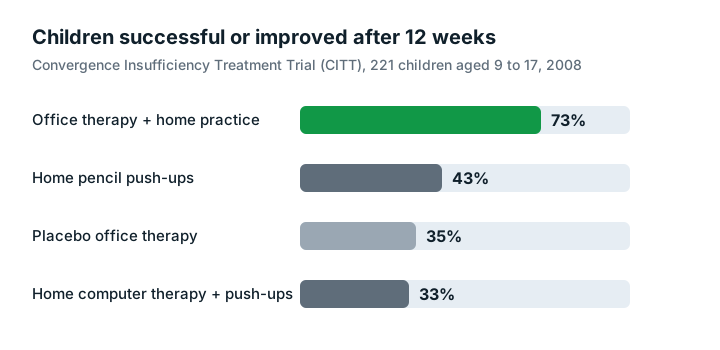
The Convergence Insufficiency Treatment Trial (CITT), published in 2008 in Archives of Ophthalmology, compared four 12-week treatments in 221 children aged 9 to 17. About 73% of children who had weekly office therapy plus 15 minutes of home practice five days a week were successful or improved. That compared with 43% for home pencil push-ups, 33% for home computer therapy plus push-ups, and 35% for placebo office therapy. On symptoms, the two home-only groups did no better than placebo.
A 2020 Cochrane review, which pooled 12 trials, reached a similar view for children: office therapy with home practice had the strongest evidence. Evidence for adults was much thinner. Not every expert reads the evidence the same way. AAPOS says home treatment is often enough and that no single option has been shown to be clearly best. Our full guide to convergence insufficiency exercises covers this in more detail.
Vision therapy at home for amblyopia (lazy eye)
Amblyopia, often called lazy eye, happens when vision in one eye does not develop fully in childhood because the brain favors the other eye. The American Academy of Ophthalmology (AAO) lists patching, blurring eye drops, blurring glasses and surgery as treatments, plus a prescribed virtual reality treatment for children aged 4 to 7. Treatment works best when started early, ideally before age 7 or 8.
The Pediatric Eye Disease Investigator Group (PEDIG) has run many of the key trials. In 2003, it found that 2 hours of daily patching worked about as well as 6 hours for moderate amblyopia in children under 7. A 2005 PEDIG trial found that treatment still helped many children aged 7 to 12, and helped teens aged 13 to 17 mainly if they had never been treated before.
Binocular or dichoptic games, where each eye sees a different part of the picture, are a newer idea. The results so far are mixed:
- In a 2016 PEDIG trial of 385 children, a binocular iPad game played 1 hour a day did not match 2 hours of daily patching. Only about 1 in 5 children in the game group did most of their assigned play.
- In a 2019 PEDIG trial of children aged 7 to 12 who had been treated before, a different binocular game added no benefit over glasses alone.
- Experts have pointed to sticking with the game as a major problem, so how engaging a program is matters.
Home vision therapy for strabismus
Strabismus means the eyes point in different directions. On its page about adult strabismus, the AAO lists surgery as the most common treatment, with prism glasses and Botox injections as other options. It mentions eye muscle exercises only for convergence insufficiency.
That means home exercises are not a stand-in for an exam and treatment plan when an eye turns. Some people with strabismus are given exercises as part of their care, but that should come from the clinician who knows your eyes.
Vision therapy at home for kids and adults
Most of the strong trials were done in children, so we know the most about kids. For children, the research points to a few practical lessons. Treatment usually works best with a clear plan and regular check-ins. Short, frequent sessions are easier to keep up than long ones. A child who loses interest stops getting the benefit, which is one reason games have drawn interest.
For adults, the evidence is weaker. The Cochrane review found only a handful of small adult convergence trials, and the results were less clear. That does not mean adults cannot benefit. It means expectations should be modest and a clinician should guide the plan.
For both ages, a few habits help:
- Practice at the same time each day, in short sessions
- Keep a simple log so your clinician can see what you did
- Stop and check in if you get new double vision, worse headaches or eye pain
- Go back for your recheck, even if you feel better
Where Optics Trainer fits in a home vision therapy program
Optics Trainer is a set of game-based vision and brain training apps for iPhone, iPad, Android, web browsers and Meta Quest. The games cover eye teaming, convergence and divergence, depth, and visual reaction. Some games give each eye its own target while both eyes stay open.
Optics Trainer is a way to practice visual skills at home. It is not a diagnosis or a treatment, and it was not tested in the trials described above. It works best alongside a plan from your eye care professional, who can tell you which skills to practice and check your progress. Optics Trainer is not a substitute for professional diagnosis or prescribed care. Consult your eye care professional for guidance about your specific condition.
If your clinician agrees that home practice fits your plan, you can try the apps free for 7 days. After that, mobile and web access is $14.99 a month.
Frequently asked questions
Does home vision therapy work?
It depends on the condition and the program. For convergence insufficiency in children, the largest trial found that office therapy with home practice worked better than home-only pencil push-ups or home computer therapy. Some eye doctor groups still say home treatment is often enough. For lazy eye, patching has the strongest evidence. Ask your eye care professional what fits your diagnosis.
Can I do vision therapy at home without seeing an eye doctor?
We do not recommend it. Similar symptoms can come from very different causes, including needing glasses. Get a comprehensive eye exam with a binocular vision evaluation first, then ask whether home practice is right for you.
What is in a home vision therapy kit?
Kits often include a Brock string, pencil push-up targets, printed cards or a computer program. The tools are simple. The plan matters more: which exercises, how long, how often, and when to recheck. Your clinician should set that plan.
Is vision therapy at home good for adults?
Adults can practice at home, but there is less research in adults than in children. A 2020 Cochrane review found only a few small adult convergence trials, with less clear results. Keep expectations modest and work with an eye care professional.
Can vision therapy at home fix a lazy eye?
Lazy eye is usually treated with glasses, patching or blurring drops, ideally in early childhood. Binocular games have been tested, but in large PEDIG trials they did not match patching, and many children stopped playing. Use any home program only as part of your eye doctor's plan.
Will home vision therapy help my child read better?
Not on its own, based on current evidence. In the CITT-ART trial, office therapy improved eye-teaming measures in children with convergence insufficiency, but reading scores improved no more than with placebo. AAPOS says vision therapy has not been shown to help dyslexia or learning problems.
Sources
- CITT Investigator Group. A randomized clinical trial of treatments for symptomatic convergence insufficiency in children. Arch Ophthalmol. 2008
- CITT-ART Investigator Group. Effect of vergence/accommodative therapy on reading in children with convergence insufficiency. Optom Vis Sci. 2019
- Scheiman M, et al. Interventions for convergence insufficiency: a network meta-analysis. Cochrane Database Syst Rev. 2020
- AAPOS. Convergence insufficiency
- AAPOS. Vision therapy
- American Academy of Ophthalmology. Amblyopia (lazy eye)
- American Academy of Ophthalmology. Adult strabismus
- AAO EyeWiki. Convergence insufficiency
- PEDIG. A randomized trial of patching regimens for treatment of moderate amblyopia in children. Arch Ophthalmol. 2003
- PEDIG. Randomized trial of treatment of amblyopia in children aged 7 to 17 years. Arch Ophthalmol. 2005
- PEDIG. A randomized trial of a binocular iPad game versus part-time patching in children aged 5 to 12 years with amblyopia. JAMA Ophthalmol. 2016
- Holmes JM. Lessons from recent randomized clinical trials of binocular treatment for amblyopia. JAMA Ophthalmol. 2018
- PEDIG. A randomized trial of binocular Dig Rush game treatment for amblyopia in children aged 7 to 12 years. Ophthalmology. 2019