Lazy Eye Exercises: What Works for Kids and Adults
Updated
Written by the Optics Trainer team from published research, with every source linked below. Not yet reviewed by a clinician.
Lazy eye exercises are tempting because they sound simple: play a game or do a drill at home and help the weaker eye catch up. Some newer home treatments do work this way, and two have FDA clearance for children. But the strongest evidence is still for glasses, patching and blurring eye drops, and many games tested in large trials did not do as well as patching. This guide explains what a lazy eye really is, how it differs from an eye that turns, what the research says about lazy eye training for kids and adults, and how to practice at home as part of a plan from your eye care professional.
What is a lazy eye? Amblyopia vs. an eye that turns
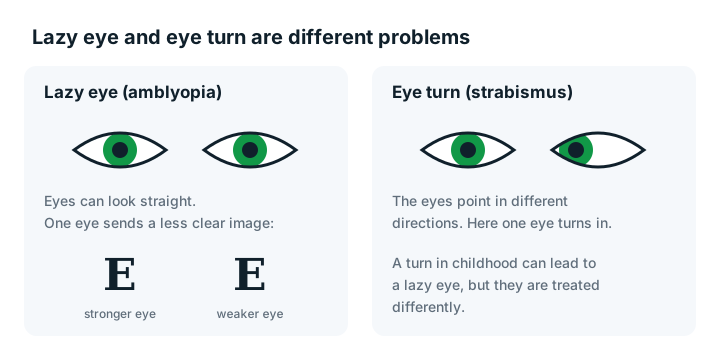
Eye doctors use the term lazy eye for amblyopia. Amblyopia means vision in one eye (rarely both) did not develop fully in childhood. The brain starts to rely on the stronger eye and pays less attention to the weaker one, so the weaker eye sees less clearly, even with glasses. The National Eye Institute (NEI) says up to 3 in 100 children have it, and that it is the most common cause of vision loss in children. The eye is not actually lazy, and the child is not doing anything wrong.
An eye that turns in, out, up or down is a different condition called strabismus. The two are easy to mix up because they often go together. A turned eye can lead to amblyopia, because the brain may ignore that eye to avoid seeing double. But amblyopia can also happen with straight eyes, for example when one eye needs a much stronger glasses prescription than the other.
The difference matters for treatment. Amblyopia treatment aims to improve how well the weaker eye sees. Strabismus treatment aims to line the eyes up. The NHS notes that surgery can straighten an eye but does not improve the vision of a lazy eye. If your main concern is an eye that turns, our guide to strabismus exercises covers that.
Start with an eye exam
Amblyopia often has no obvious signs. A child may see well with the stronger eye and never complain. NEI recommends that all children have a vision screening at least once between ages 3 and 5.
Only an eye exam can tell whether a child has amblyopia, what is causing it, and whether glasses are needed. Common causes include a large difference in prescription between the eyes, an eye turn, and, less often, something blocking vision, such as a cataract or a droopy eyelid. The cause shapes the plan, so it is worth getting it right before starting any exercises.
Lazy eye treatment with the strongest evidence
The American Academy of Ophthalmology (AAO), NEI and the American Association for Pediatric Ophthalmology and Strabismus (AAPOS) all describe the same core treatments. Most of them are done at home, but they are prescribed and checked by an eye doctor.
- Glasses: Often the first step. In a Pediatric Eye Disease Investigator Group (PEDIG) study of 84 children aged 3 to 6, glasses alone improved vision in the weaker eye by at least 2 lines in 77% of children and cleared the amblyopia in 27%. Some needed up to 30 weeks of glasses wear to stop improving.
- Patching: Covering the stronger eye for part of the day so the brain has to use the weaker eye.
- Atropine eye drops: A daily drop that blurs the stronger eye. In a 2002 PEDIG trial of 419 children under 7, patching and atropine improved vision by a similar amount after 6 months.
- Treating the cause: For example, surgery for a cataract or droopy eyelid, often followed by patching.
Lazy eye exercises, games and VR: what the research says
Most lazy eye games are binocular, or dichoptic. Each eye sees a different part of the picture, so the brain has to use both eyes together. This is different from old-style drills, and it is the approach that has been tested in trials. The results depend on the product and how much children actually use it.
Several large trials of tablet games were disappointing:
- In a 2016 PEDIG trial of 385 children aged 5 to 12, a binocular iPad game for 1 hour a day did not match 2 hours of daily patching. Only about 1 in 5 children in the game group did most of their assigned play.
- In a 2019 PEDIG trial of children aged 7 to 12, nearly all of whom had been treated before, a binocular game called Dig Rush added no benefit over glasses alone.
- In a 2022 PEDIG trial of children aged 4 to 6, the same game helped a little more than glasses alone at 4 weeks, but the difference was gone by 8 weeks.
- A 2022 Cochrane review found only one eligible trial comparing binocular treatment with patching in children aged 3 to 8. The gains looked similar to patching at 16 weeks, but the authors said there was not yet enough long-term data to draw firm conclusions.
FDA-cleared digital and VR lazy eye treatments
Two digital home treatments are listed by the FDA in its category for digital therapy devices for amblyopia. Both are prescription treatments for children whose amblyopia comes from a difference in prescription between the eyes and/or a mild eye turn, and both are meant to be used along with full-time glasses.
Luminopia is a VR headset program that changes TV shows and movies so the brain has to use both eyes. The FDA granted it in October 2021 for children aged 4 to 7, and in April 2025 cleared it for ages 4 to under 13. In its main trial of 105 children aged 4 to 7, children who used it 1 hour a day, 6 days a week, plus glasses, gained about 1.8 lines of vision in the weaker eye after 12 weeks, compared with 0.8 lines for glasses alone.
CureSight, made by NovaSight, uses colored glasses and an eye tracker while a child watches videos. The FDA cleared it in September 2022 for children aged 4 to under 9. In its main trial of 103 children, 90 minutes a day for 16 weeks worked as well as 2 hours of daily patching.
These results show that some well-designed digital treatments can help children with amblyopia. They do not mean that any game or app will. Each of these products was tested in its own trial, with its own design, dose and age range, under an eye doctor's prescription.
Lazy eye exercises for kids, teens and adults
Age makes a big difference. The AAO says amblyopia is best treated before age 7 or 8. Treatment can still help older children. In a 2005 PEDIG trial, about half of children aged 7 to 12 improved with patching, near activities and atropine, compared with a quarter with glasses alone. For teens aged 13 to 17, patching mainly helped those who had never been treated before. AAPOS says starting treatment up to about age 14 can still help, but less than starting younger.
For adults, the evidence is weak. AAPOS says current amblyopia treatments do not work for adults, and NEI says treatment is usually less effective in adults than in children. In the BRAVO trial of 115 people aged 7 and older, with an average age of about 21, a binocular falling-blocks game played 1 hour a day for 6 weeks did no better than a placebo version of the game. Earlier lab studies had looked promising, but that did not hold up in this home-based trial.
So for adults, we cannot honestly say that lazy eye exercises will improve vision in the weaker eye. If you are an adult with amblyopia, an eye exam is still worth it to check your glasses, protect your stronger eye and talk through what is realistic.
Can you fix a lazy eye at home? Where Optics Trainer fits
Much of lazy eye treatment already happens at home: wearing glasses, patching, putting in drops, or using a prescribed digital treatment. What does not work well is a do-it-yourself plan without a diagnosis or follow-up. The research also shows that sticking with treatment is one of the biggest challenges, whatever the method.
Optics Trainer is a set of game-based vision and brain training apps for iPhone, iPad, Android, web browsers and Meta Quest. It includes binocular games where each eye gets its own target while both eyes stay open, plus eye teaming, depth and visual reaction games. It is a way to practice visual skills at home. It is not a diagnosis or a treatment for amblyopia, and it was not tested in any of the trials described above.
Optics Trainer is not a substitute for professional diagnosis or prescribed care. Consult your eye care professional for guidance about your specific condition. If your clinician agrees that home practice fits alongside your plan, you can try the apps free for 7 days. After that, mobile and web access is $14.99 a month.
Frequently asked questions
Do lazy eye exercises work?
It depends on what you mean by exercises. Some prescribed binocular treatments, such as the FDA-cleared Luminopia and CureSight, improved vision in children in their trials. But several large trials of tablet games did not match patching or did not beat glasses alone. Glasses, patching and atropine drops have the strongest evidence.
Can you fix a lazy eye at home?
Most lazy eye treatment is done at home, but it should be prescribed and checked by an eye doctor. Glasses, patching, blurring drops and some digital treatments are all used at home. A plan without a diagnosis may miss the cause, such as a need for glasses.
How long does it take to fix a lazy eye?
NEI says vision often starts to improve within weeks, but the best results usually take months. In trials, treatment was usually checked after 12 to 16 weeks, and some children needed up to 30 weeks of glasses alone before their vision stopped improving. Some children need more treatment later to keep the gains.
Can adults fix a lazy eye with exercises?
The evidence does not support this. AAPOS says current amblyopia treatments do not work for adults, and in a trial that included adults, a binocular game did no better than a placebo game. An eye exam is still useful to check glasses and eye health.
Is VR good for lazy eye?
One VR treatment, Luminopia, is FDA cleared for children aged 4 to under 13 with certain types of amblyopia, and it improved vision more than glasses alone in its trial. That result applies to that product, used as prescribed. It does not show that other VR games treat lazy eye.
Is a lazy eye the same as a crossed eye?
No. A lazy eye (amblyopia) means one eye does not see as clearly because vision did not develop fully. A crossed or turned eye is strabismus. They often happen together, and a turned eye can cause amblyopia, but they are treated differently.
Are there lazy eye exercise apps?
Yes, there are many apps and games, including Optics Trainer. Only a few digital products have FDA clearance as amblyopia treatments, and most apps have not been tested in trials. Use any app only alongside your eye care professional's plan.
Sources
- American Academy of Ophthalmology. Amblyopia (lazy eye)
- National Eye Institute. Amblyopia (lazy eye)
- AAPOS. Amblyopia
- NHS. Lazy eye
- PEDIG. A randomized trial of atropine vs. patching for treatment of moderate amblyopia in children. Arch Ophthalmol. 2002
- Cotter SA, et al. Treatment of anisometropic amblyopia in children with refractive correction. Ophthalmology. 2006
- PEDIG. Randomized trial of treatment of amblyopia in children aged 7 to 17 years. Arch Ophthalmol. 2005
- PEDIG. Effect of a binocular iPad game vs part-time patching in children aged 5 to 12 years with amblyopia. JAMA Ophthalmol. 2016
- PEDIG. A randomized trial of binocular Dig Rush game treatment for amblyopia in children aged 7 to 12 years. Ophthalmology. 2019
- PEDIG. A randomized trial of binocular Dig Rush game treatment for amblyopia in children aged 4 to 6 years. Optom Vis Sci. 2022
- Tailor V, et al. Binocular versus standard occlusion or blurring treatment for unilateral amblyopia in children aged three to eight years. Cochrane Database Syst Rev. 2022
- Xiao S, et al. Randomized controlled trial of a dichoptic digital therapeutic for amblyopia. Ophthalmology. 2022
- Wygnanski-Jaffe T, et al. An eye-tracking-based dichoptic home treatment for amblyopia: a multicenter randomized clinical trial. Ophthalmology. 2023
- Gao TY, et al. Effectiveness of a binocular video game vs placebo video game for improving visual functions in older children, teenagers, and adults with amblyopia. JAMA Ophthalmol. 2018
- US FDA. De Novo DEN210005: Luminopia One. 2021
- US FDA. 510(k) K243819: Luminopia. 2025
- US FDA. 510(k) K221375: CureSight-CS100. 2022