Strabismus Exercises: When They Help and When They Don't
Updated
Written by the Optics Trainer team from published research, with every source linked below. Not yet reviewed by a clinician.
Strabismus exercises are often searched by people hoping to straighten an eye that turns without glasses or surgery. The honest answer is that exercises help some types of eye-teaming problems and do not help many others. They have good evidence for convergence insufficiency, early and mixed evidence for intermittent exotropia, and little or no evidence for constant, large or nerve-related eye turns. This guide explains what strabismus is, which types exercises may help, where they do not, why a new eye turn needs a prompt exam, and how to fit home practice into your eye care professional's plan.
What is strabismus?
Strabismus means the eyes do not line up. One eye looks straight ahead while the other turns in, out, up or down. The turn can be there all the time or come and go. AAPOS estimates about 4% of people in the US have it. In the UK it is often called a squint.
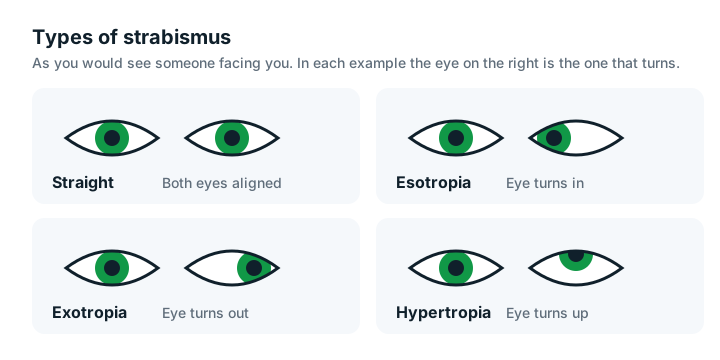
Doctors name strabismus by the direction of the turn:
- Esotropia: the eye turns in toward the nose (crossed eyes)
- Exotropia: the eye turns out toward the ear
- Hypertropia or hypotropia: the eye turns up or down
Strabismus vs. lazy eye
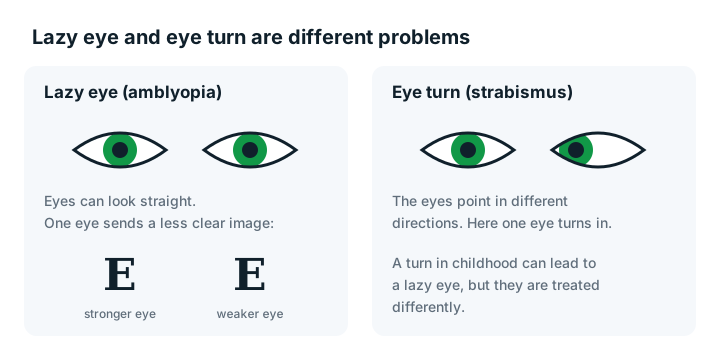
Strabismus is about where the eyes point. Lazy eye, or amblyopia, is about how clearly one eye sees. They are different conditions, but they are linked. In a child, a turned eye can lead to amblyopia, because the brain may ignore that eye to avoid double vision. That is one reason an eye turn in a child should be checked early, even if it does not seem to bother them.
If you have heard lazy eye used for an eye that drifts or turns, that eye turn is strabismus. Our guide to lazy eye exercises covers amblyopia treatment.
A new eye turn needs a prompt exam
Exercises are never the first step for a new eye turn, in a child or an adult. Strabismus can be a sign of another problem that needs care.
In children, AAPOS says an eye that crosses all the time, at any age, should be seen by a pediatric ophthalmologist. Eyes that wander now and then are common in babies under about 3 to 4 months, but a turn that keeps happening after that should be checked. The NHS advises that any child with a squint see a doctor, partly to rule out rare but serious causes such as an eye tumor called retinoblastoma.
In adults, the AAO lists causes of new strabismus such as stroke, thyroid eye disease, diabetes, myasthenia gravis, brain tumors and head injury. The NHS says sudden double vision needs an urgent appointment. Double vision with a severe headache or an enlarged pupil, or after a head injury, is an emergency.
Can eye exercises help strabismus? Where the evidence is strongest
Convergence insufficiency (CI) is where exercises have the best support. In CI the eyes have trouble turning inward together for close work like reading, and may drift out. AAPOS puts it plainly about exotropia: "Exercises have only been proven to work with convergence insufficiency." The AAO's adult strabismus page also mentions eye muscle exercises mainly for CI.
Even for CI, the type of program matters. In the 2008 Convergence Insufficiency Treatment Trial (CITT) of 221 children aged 9 to 17, weekly office therapy with home practice worked better than home pencil push-ups, home computer therapy, or placebo. A 2020 Cochrane review agreed for children and found the adult evidence less clear. Our guide to convergence insufficiency exercises covers this in detail.
Exotropia exercises and intermittent exotropia
Intermittent exotropia (IXT) is an outward drift that comes and goes, often when a child is tired, ill, daydreaming or looking far away. It is the type people most often hope to fix with exotropia exercises.
AAPOS says exercises have not been proven to help IXT. The large PEDIG trials of IXT tested patching, special glasses and watchful waiting, not exercises. In those trials, part-time patching gave a small benefit, and a 2021 Cochrane review agreed. Overminus glasses improved control while children wore them, but the benefit faded after they stopped.
Newer, smaller trials from other research groups suggest some therapy may help some children:
- A 2024 single-center trial of 40 children and teens found office-based vergence and anti-suppression therapy improved control of the drift at 17 weeks compared with observation. The authors said a larger trial is needed to test long-term results.
- A 2026 trial of 177 children aged 6 to 18 in China tested a home VR vision therapy program for 12 weeks. Control improved only modestly overall, with bigger gains in children who did more than 75% of their training. Long-term follow-up was still under way.
- None of these trials show that exercises remove the need for glasses or surgery when the drift is frequent, large or causing symptoms.
Where strabismus exercises do not help
For many types of strabismus, exercises are not a proven treatment, and relying on them can delay care that works. AAPOS and the AAO list glasses, patching, prisms, Botox and surgery for these cases, not exercises:
- Infantile esotropia: an inward turn in the first year of life. AAPOS says it usually needs eye muscle surgery, often before age 2.
- Accommodative esotropia: crossing linked to farsightedness. Glasses are the main treatment and should be worn all the time.
- Constant or large-angle turns: these usually need glasses, surgery or both.
- Turns caused by nerve, muscle or brain problems, such as after a stroke, head injury or thyroid eye disease. These need a medical workup first.
Strabismus exercises for adults and kids, and where Optics Trainer fits
Most strabismus research is in children. For adults, the AAO lists surgery as the most common treatment, with prism glasses and Botox as other options, and exercises mainly for convergence insufficiency. The Cochrane review found adult CI evidence less clear than for children. Adults should expect modest results from exercises and should have any new turn checked first.
Optics Trainer is a set of game-based vision and brain training apps for iPhone, iPad, Android, web browsers and Meta Quest. It includes eye teaming, convergence and divergence, depth and visual reaction games, plus binocular games where each eye gets its own target while both eyes stay open. It is a way to practice visual skills at home. It is not a diagnosis or a treatment for strabismus, it will not straighten an eye turn on its own, and it was not tested in the trials described above.
Optics Trainer is not a substitute for professional diagnosis or prescribed care. Consult your eye care professional for guidance about your specific condition. If your clinician agrees that home practice fits your plan, you can try the apps free for 7 days. After that, mobile and web access is $14.99 a month.
Frequently asked questions
Can eye exercises fix strabismus?
Only for some types. Exercises have good evidence for convergence insufficiency, and early, mixed evidence for intermittent exotropia. For infantile esotropia, crossing linked to farsightedness, constant or large turns, and turns caused by nerve or muscle problems, the main treatments are glasses, patching, prisms, Botox or surgery.
Do strabismus exercises work for adults?
They can help some adults with convergence insufficiency, but the evidence in adults is weaker than in children. For most other adult eye turns, the AAO lists surgery, prism glasses and Botox. A new eye turn in an adult should be checked promptly, because it can be a sign of another health problem.
Does strabismus correct itself?
Sometimes in young babies. Eyes that wander now and then are common in the first few months, and in one PEDIG study about a quarter of infants with early crossing got better on their own, mostly those whose turn came and went. After that, the NHS says a squint is unlikely to improve on its own. Intermittent exotropia often stays stable for years but rarely goes away completely.
Are there exercises for exotropia?
Yes, but the evidence is limited. AAPOS says exercises are proven only for convergence insufficiency, not intermittent exotropia. Two newer trials found office-based therapy and a home VR program improved control for some children, but the gains were modest or short-term so far. Ask a pediatric ophthalmologist or orthoptist whether therapy fits your child.
Are squint eye exercises the same as strabismus exercises?
Yes. Squint is the common UK word for strabismus. The NHS says exercises may sometimes help the eyes work together better, alongside other treatments such as glasses, patching, injections or surgery.
When should I see a doctor about an eye turn?
Soon, for any new eye turn in a child or adult, any constant crossing at any age, or a turn in a baby that keeps happening after about 3 to 4 months. Get urgent help for sudden double vision, and emergency care if double vision comes with a severe headache, an enlarged pupil or a head injury.
Sources
- American Academy of Ophthalmology. What is adult strabismus?
- AAPOS. Strabismus
- AAPOS. Exotropia
- AAPOS. Esotropia
- AAPOS. Infantile esotropia
- AAPOS. Accommodative esotropia
- AAPOS. Vision therapy
- NHS. Squint
- NHS. Double vision
- CITT Study Group. Randomized clinical trial of treatments for symptomatic convergence insufficiency in children. Arch Ophthalmol. 2008
- Scheiman M, et al. Interventions for convergence insufficiency: a network meta-analysis. Cochrane Database Syst Rev. 2020
- Pang Y, et al. Interventions for intermittent exotropia. Cochrane Database Syst Rev. 2021
- PEDIG. A randomized trial comparing part-time patching with observation for children 3 to 10 years of age with intermittent exotropia. Ophthalmology. 2014
- PEDIG. Three-year observation of children 3 to 10 years of age with untreated intermittent exotropia. Ophthalmology. 2019
- Chen AM, et al. Overminus lens therapy for children 3 to 10 years of age with intermittent exotropia. JAMA Ophthalmol. 2021
- Ma MM, et al. Office-based vergence and anti-suppression therapy for the treatment of small-to-moderate angle intermittent exotropia. Ophthalmic Physiol Opt. 2024
- Jing Y, et al. Virtual reality-based vision therapy for intermittent exotropia: a randomized clinical trial. JAMA Netw Open. 2026
- PEDIG. Spontaneous resolution of early-onset esotropia. Am J Ophthalmol. 2002